Thursday, March 22, 2007
Bacterial Bait and Switch: Germs Tricked into Absorbing Wrong Element
Bacterial Bait and Switch: Germs Tricked into Absorbing Wrong Element
March 19 2007
Bacterial Bait and Switch: Germs Tricked into Absorbing Wrong Element
Antibiotics, the wonder drugs of the mid-20th century, are starting to run out steam. The Food and Drug Administration (FDA) estimates that 70 percent of bacteria responsible for infections contracted in-hospital have become immune to the antibiotics once able to kill them. The worry is that these treatments will eventually become impotent against powerful new bacterial superstrains that are emerging. As a result, scientists have been trying to find potential new drugs to replace weakening ones.
Now researchers have come up with a possible substitute that utilizes the metal gallium to mimic iron needed by bacteria need to survive. Rather than a drug designed to attack the bacteria itself, gallium boosts of the body's own natural defenses by fooling bacteria into thinking they are well-nourished.
"This approach might intensify a stress already imposed on a bacteria by host defenses," says study co-author Pradeep Singh, assistant professor of medicine and microbiology at the University of Washington School of Medicine. "The immune system has got the bacteria in an armlock and the belly's exposed, and we try to give it a sucker punch in the kidney."
The new approach, described in the April 2 issue of the Journal of Clinical Investigation, takes advantage of bacteria's dependence on iron, which is a constituent of many of their essential enzymes. Iron is also necessary for bacteria to form biofilms, clusters of cells that adhere to surrounding tissue. Once the body detects a bacterial invader, the immune system gobbles up free iron and locks up any stores of the element.
That is where gallium comes in. Despite the element's position five spots from iron on the periodic table, many biological systems are unable to distinguish it from an iron ion. Singh, using methodology co-developed with study co-author Bradley Britigan of the University of Cincinnati, tested bacterial suspensions both in vitro and in mouse models to see if iron-starved bacteria would feel sated in the presence of the beguilingly similar element.
The team observed that small concentrations of gallium—mixed with nitric acid to become gallium nitrate in test tubes—could inhibit the growth of Pseudomonas aeruginosa, an antibiotic-resistant pathogen that commonly infects the impaired lungs of patients with cystic fibrosis (an incurable disease in which there is a mucus buildup in the lungs and pancreas; over half of the disorder's sufferers do not make it to age 18). Higher concentrations of the metal destroyed the bacteria at dosages less potent than those approved by the FDA to intravenously reduce excess calcium in the blood. When subject mice inhaled a gallium solution, the element countered acute, typically fatal amounts of P. aeruginosa. To mimic this Trojan horse's effectiveness against chronic exposure to the bacteria, the metal was pitted against a biofilm (which over time allows the bacteria to acquire a resistance 1,000 times stronger than as free-flowing cells, according to Singh) in the mouse's lungs. The new treatment reduced bacterial counts 1,000-fold.
Singh and his colleagues analyzed the genes in the bacterial cell to determine which ones were vulnerable to the gallium solution. The gallium apparently causes "everything to go haywire in the iron sensing of the bacteria," Singh says, noting that the genetic profile seemed to indicate a particular cell was simultaneously iron-starved and iron-replete.
Despite the resounding success of both the test tube and mouse studies, however, Singh stressed that gallium has yet to go through human clinical trials. But he says that he is optimistic about the gallium's potential, especially as a treatment for cystic fibrosis, which currently has no cure. The goal, he says, is "to have patients inhale gallium and achieve higher concentrations in the lungs and lower concentrations in the rest of the body," because gallium nitrate has been found to impair kidney function.
Unfortunately, he says it is iffy whether gallium could prevent bacteria from mutating into forms that would resist it. "Like any antimicrobial agent," he concedes, "there is the probability that resistance would grow over time."
Scientific American
March 19 2007
Bacterial Bait and Switch: Germs Tricked into Absorbing Wrong Element
Antibiotics, the wonder drugs of the mid-20th century, are starting to run out steam. The Food and Drug Administration (FDA) estimates that 70 percent of bacteria responsible for infections contracted in-hospital have become immune to the antibiotics once able to kill them. The worry is that these treatments will eventually become impotent against powerful new bacterial superstrains that are emerging. As a result, scientists have been trying to find potential new drugs to replace weakening ones.
Now researchers have come up with a possible substitute that utilizes the metal gallium to mimic iron needed by bacteria need to survive. Rather than a drug designed to attack the bacteria itself, gallium boosts of the body's own natural defenses by fooling bacteria into thinking they are well-nourished.
"This approach might intensify a stress already imposed on a bacteria by host defenses," says study co-author Pradeep Singh, assistant professor of medicine and microbiology at the University of Washington School of Medicine. "The immune system has got the bacteria in an armlock and the belly's exposed, and we try to give it a sucker punch in the kidney."
The new approach, described in the April 2 issue of the Journal of Clinical Investigation, takes advantage of bacteria's dependence on iron, which is a constituent of many of their essential enzymes. Iron is also necessary for bacteria to form biofilms, clusters of cells that adhere to surrounding tissue. Once the body detects a bacterial invader, the immune system gobbles up free iron and locks up any stores of the element.
That is where gallium comes in. Despite the element's position five spots from iron on the periodic table, many biological systems are unable to distinguish it from an iron ion. Singh, using methodology co-developed with study co-author Bradley Britigan of the University of Cincinnati, tested bacterial suspensions both in vitro and in mouse models to see if iron-starved bacteria would feel sated in the presence of the beguilingly similar element.
The team observed that small concentrations of gallium—mixed with nitric acid to become gallium nitrate in test tubes—could inhibit the growth of Pseudomonas aeruginosa, an antibiotic-resistant pathogen that commonly infects the impaired lungs of patients with cystic fibrosis (an incurable disease in which there is a mucus buildup in the lungs and pancreas; over half of the disorder's sufferers do not make it to age 18). Higher concentrations of the metal destroyed the bacteria at dosages less potent than those approved by the FDA to intravenously reduce excess calcium in the blood. When subject mice inhaled a gallium solution, the element countered acute, typically fatal amounts of P. aeruginosa. To mimic this Trojan horse's effectiveness against chronic exposure to the bacteria, the metal was pitted against a biofilm (which over time allows the bacteria to acquire a resistance 1,000 times stronger than as free-flowing cells, according to Singh) in the mouse's lungs. The new treatment reduced bacterial counts 1,000-fold.
Singh and his colleagues analyzed the genes in the bacterial cell to determine which ones were vulnerable to the gallium solution. The gallium apparently causes "everything to go haywire in the iron sensing of the bacteria," Singh says, noting that the genetic profile seemed to indicate a particular cell was simultaneously iron-starved and iron-replete.
Despite the resounding success of both the test tube and mouse studies, however, Singh stressed that gallium has yet to go through human clinical trials. But he says that he is optimistic about the gallium's potential, especially as a treatment for cystic fibrosis, which currently has no cure. The goal, he says, is "to have patients inhale gallium and achieve higher concentrations in the lungs and lower concentrations in the rest of the body," because gallium nitrate has been found to impair kidney function.
Unfortunately, he says it is iffy whether gallium could prevent bacteria from mutating into forms that would resist it. "Like any antimicrobial agent," he concedes, "there is the probability that resistance would grow over time."
Scientific American
Labels: antimicrobial agent, Bacteria; Proteobacteria; Betaproteobacteria; Burkholderiales; Burkholderiaceae, gallium
# posted by Pat O'Connor @ 10:27 AM

Friday, February 09, 2007
A case of prostatitis due to Burkholderia pseudomallei.
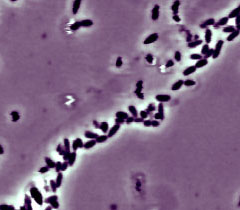
A case of prostatitis due to Burkholderia pseudomallei.
Nat Clin Pract Urol. 2007 Feb
Arzola JM,
Hawley JS,
Oakman C,
Mora RV.
Wilford Hall Medical Center, Urology, 8423 Feather Trail, Helotes, TX 78023, USA. jorge.arzola@lackland.af.mil
Burkholderia fungorum. From DOE Joint Genome Institute
BACKGROUND: A 67-year-old male, with a history of stable lower urinary tract symptoms, diabetes mellitus, benign prostatic hyperplasia, gonococcal urethritis, and excessive alcohol consumption, presented to the emergency room with sepsis and acute bacterial prostatitis. He had recently returned from a visit to Indonesia, where he had been a first-hand witness to the 2004 tsunami.
INVESTIGATIONS: Complete blood cell count, urine analysis, blood, urine, and prostatic abscess cultures, chest X-ray, contrasted CT of the abdomen and pelvis, and (18)F-fluorodeoxyglucose PET.
DIAGNOSIS: Melioidosis.
MANAGEMENT: Broad-spectrum empiric antibiotics were administered initially; therapy was then changed to intravenous imipenem plus cilastatin with slow initial clinical improvement. (18)F-fluorodeoxyglucose PET localized the prostate as the only nidus of infection. Ultrasound-guided fine needle aspiration of a small fluid collection of the prostate also grew Burkholderia pseudomallei. The patient improved clinically and was discharged to complete a 2-week course of intravenous imipenem plus cilastatin followed by a 3-month course of oral trimethoprim plus sulfamethoxazole. This medication was switched to co-amoxiclav and doxycycline to complete the 3-month course. The patient was well at his last follow-up, 3 months following hospital discharge.
PMID: 17287872 [PubMed - in process]
Related Article:
Burkholderia
Classification
Higher order taxa:
Bacteria; Proteobacteria; Betaproteobacteria; Burkholderiales; Burkholderiaceae
Species:
Burkholderia andropogonis; Burkholderia brasilensis; Burkholderia caledonica; Burkholderia caribensis; Burkholderia caryophylli; Burkholderia fungorum; Burkholderia gladioli; Burkholderia glathei; Burkholderia glumae; Burkholderia graminis; Burkholderia hospita; Burkholderia kururiensis; Burkholderia mallei; Burkholderia phenazinium; Burkholderia phymatum; Burkholderia phytofirmans; Burkholderia plantarii; Burkholderia sacchari; Burkholderia singaporensis; Burkholderia sordidicola; Burkholderia symbiont of Asellus aquaticus; Burkholderia terricola; Burkholderia tropica; Burkholderia tuberum; Burkholderia ubonensis; Burkholderia unamae; Burkholderia xenovorans; Burkholderia sp.; Burkholderia cepacia complex: Burkholderia ambifaria; Burkholderia anthina; Burkholderia cenocepacia; Burkholderia cepacia; Burkholderia dolosa; Burkholderia multivorans; Burkholderia pyrrocinia; Burkholderia stabilis; Burkholderia vietnamiensis
Description and Significance
Burkholderia bacteria are both human and plant pathogens as well as environmentally important bacteria. Burkholderia fungorum strain LB400 and other closely related Burkhoderia strains are good biodegraders of polychlorinated biphenyls (PCBs) with "unparalleled ability to destroy environmentally important PCB congeners" (DOE). Conversely, Burkholderia pseudomallei is the causative agent of melioidosis, as disease that harms both humans and animals, as well as septicemia and pneumonia in susceptible individuals (Godoy et al. 2003).
Genome Structure
Burkholderia fungorum is presently being sequenced by the DOE Joint Genome Institute. It has three large replicons (chromosomes) and a megaplasmid with a total of 8.1 Mb. Apparently, the large size of genomic material, which is among the larges of the soil bacteria known, may contribute to its "ecological success." Because this and related PCB-degrading bacteria have such important ecological and commerical potential for bioremediation technologies, sequencing this genome will be extremely important in shedding light on the mechanisms and organization responsible for the group's metabolic and environmental versatility. This knowledge will allow new development of "novel environmental remediation technologies and products for plant growth promotion" (DOE).
Cell Structure and Metabolism
Burkholderia bacteria are rod-shaped, motile, Gram-negative bacteria that are capable of both pathogenic characteristics and degrading PCBs. The bacteria are also generally obligately aerobic. Of the bacterial isolates found in the Arctic that are able to degrade PCBs, none used compounds such as 2-chlorobiphenyl, 3-chlorobiphenyl, camphor, citronellol, cymene, dehydroabietic acid, limonene, methanol, n-hexadecane, pentachlorophenol, phenol, or pinene as primary growth substrates (Master and Mohn 1998).
Ecology
Burkholderia bacteria are commonly found in the soil and in groundwater worldwide. Burkholderia and related bacteria have been found at soils of all tempuratures including Arctic soil of 7oC.
Pathology
Burkholderia pseudomallei is generally considered a saprophyte (grows on and uses dead or decaying organic matter as an energy source), it also causes the infectious disease melioidosis that is mostly restricted to Southeast Asia, northern Australia, and some other tropical and subtropical regions. It also occasionally causes serious invasive diseases like septicemia and pneumonia in susceptible individuals. Although the epidemiology of melioidosis is not yet fully understood, it is thought that infections are contracted by contact with the organism from contaminated ground water ("for example, in rice paddies") through puncture wounds, cuts, or abrasions in the skin (Godoy et al. 2003). Burkholderia mallei, which is very closely related to B. pseudomallei, causes glanders in horses and other equines and occasionally in humans and other animals. This disease is generally found in parts of Africa, Asia, the Middle East, and Central and South America. The human B. mallei infection is very close to an infection of B. pseudomallei (Godoy et al. 2003). In horses, the bacterial acute infection causes the development of "rapidly spreading ulcers in skin and nasal mucosa" as well as "death within a few days from septicaemia" (VEIN). The chronic disease caused by B. mallei, which is more common, results in lesions and pulmonary involvement. It can manifest in nasal form, skin form, or both nasal and skin form at the same time. Both of B. mallei and B. pseudomallei are considered potential agents of biological warfare or bioterrorism -- CDC lists them in category B of the list of bioterrorism agents (Godoy et al. 2003) . In addition to all this, Burkholderia cepacia is a pathogen associated with chronic lung disease in cystic fibrosis patients (Kiska et al. 1995).
References
General:
DOE Joint Genome Institute: Burkholderia fungorum
Godoy, Daniel, Gaynor Randle, Andrew J. Simpson, David M. Aanensen, Tyrone L. Pitt, Reimi Kinoshita, and Brian G. Spratt. 2003. "Multilocus sequence typing and evolutionary relationships among the causative agents of melioidosis and glanders, Burkholderia pseudomallei and Burkholderia mallei." Journal of Clinical Microbiology, vol. 41, no. 5. American Society for Microbiology. (2068-2079)
Master, Emma R. and William W. Mohn. 1998. "Psychrotolerant bacteria isolated from Arctic soil that degrade polychlorinated biphenyls at low tempuratures." Applied and Environmental Microbiology, vol. 64, no. 12. American Society for Microbiology. (4823-4829)
Pathology
Veterinary Education and Information Network: Exotic Diseases: Dermatolotical Diseases: Glanders
Microbe Wiki
Labels: Bacteria; Proteobacteria; Betaproteobacteria; Burkholderiales; Burkholderiaceae
# posted by Pat O'Connor @ 8:18 AM

